Trésor Consult
Clarity check
Private R&D interface

Start with the messy.

There are two good ways in. Bring the commercial decision that keeps reopening, or see how Trésor thinks before you give us anything.

What brought you here?
No wrong door. You can switch at any point.

Do not try to make it sound strategic. Write the thing that keeps coming back.

Not sure how to phrase it?
We are choosing between ___ and ___.We keep coming back to ___.I think ___, but I do not trust the evidence yet.
No deck. No upload. Nothing is sent yet.

The first read uses automated analysis. Do not enter passwords, credentials, or customer personal data.

Let me check what I heard
You gave me

Correct me in fragments if you want. What are the things pulling you in different directions?

No need to make it neat.
Thirty seconds

Bring one consequential commercial choice. We help you see what should actually decide it.

That is the shortest explanation of Trésor. We separate the choice from the surrounding noise, place it in the right company context, show which evidence deserves weight, and make clear what would change the current view.

01
Bring the messy decision.

No pitch deck version. No performance of certainty.

02
Make the choice visible.

We identify the commercial object, place it in company context, and separate signal from surrounding noise.

03
Let evidence carry the weight.

You see what should decide the question, what we distrust, the smallest useful test, and what would change the current view.

Specialist boundary

Good judgment includes knowing where it stops.

Trésor stays with the commercial question, the evidence, the trade-offs and the decision. When the work genuinely becomes specialist, we bring in selected people with depth in that work rather than pretending broader competence. Scope, responsibilities, economics and client boundaries are agreed before anything begins.

Ideas in progress / public drawing set

The Working Draft

A public record of thinking becoming clearer. We publish the question, the current drawing, the evidence we trust, and the thing that would make us redraw it.

How to use this Read nothing unless the question interests you. Open one drawing set, skim the labels, leave when it stops being useful. The archive is here to expose the thinking, not demand your attention.
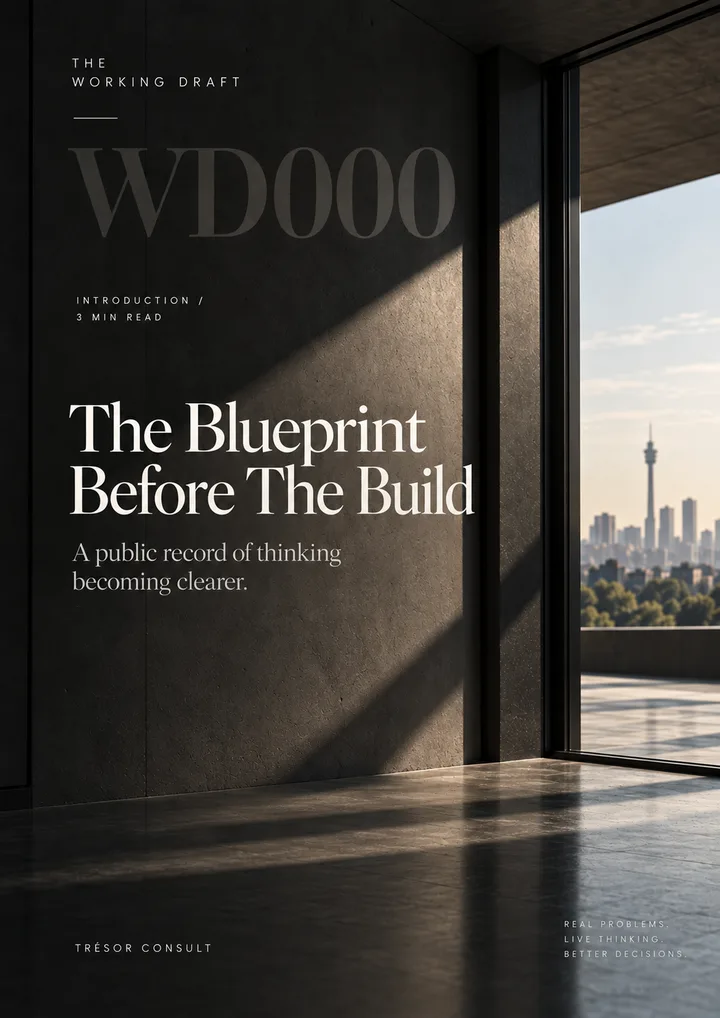
000 The Blueprint Before The BuildIntroduction / 3 min read
The Working Draft introduction cover, an architectural interior with Johannesburg beyond the window.
WD000 / Cover sheet
Before the drawings

Most companies show you the building after the scaffolding comes down. We want to show you the drawings.

The Working Draft is where Trésor publishes ideas while they are still being tested against reality. Not unfinished because we have not thought enough. Unfinished because reality has not finished answering yet.

Purpose

A drawing set, not a doctrine.

Think of each edition less like an article and more like a drawing set. A plan shows what we currently believe should exist. A section shows how the pieces are meant to work together. A detail shows where the thinking becomes specific. A revision shows what reality forced us to change.

We work on commercial decisions. The dangerous thing about decisions is how quickly a plausible idea can begin to feel like a fact. This series preserves the movement between the two.

The questions

What did we believe, and what earned the revision?

01What did we believe?
02Why did we believe it?
03What did we build because of it?
04What did people actually do?
05What survived, and what changed?
Reading rule

The drafts are allowed to disagree.

If WD004 contradicts WD001 because customers taught us something the first version could not see, the archive has done its job.

Nothing here should be treated as doctrine simply because it has been designed beautifully. A hypothesis is still a hypothesis. An observation is still an observation. A repeated pattern earns more weight. A principle has to survive reality more than once.

Your role

Do not become a design critic for us.

Use what we build. Notice where you hesitate. Notice what feels unexpectedly clear. Notice what requires explanation that should not require explanation. Notice what you ignore. Notice what makes you want to continue.

If something is wrong, tell us what happened between you and the thing we made. That interaction is part of the material.
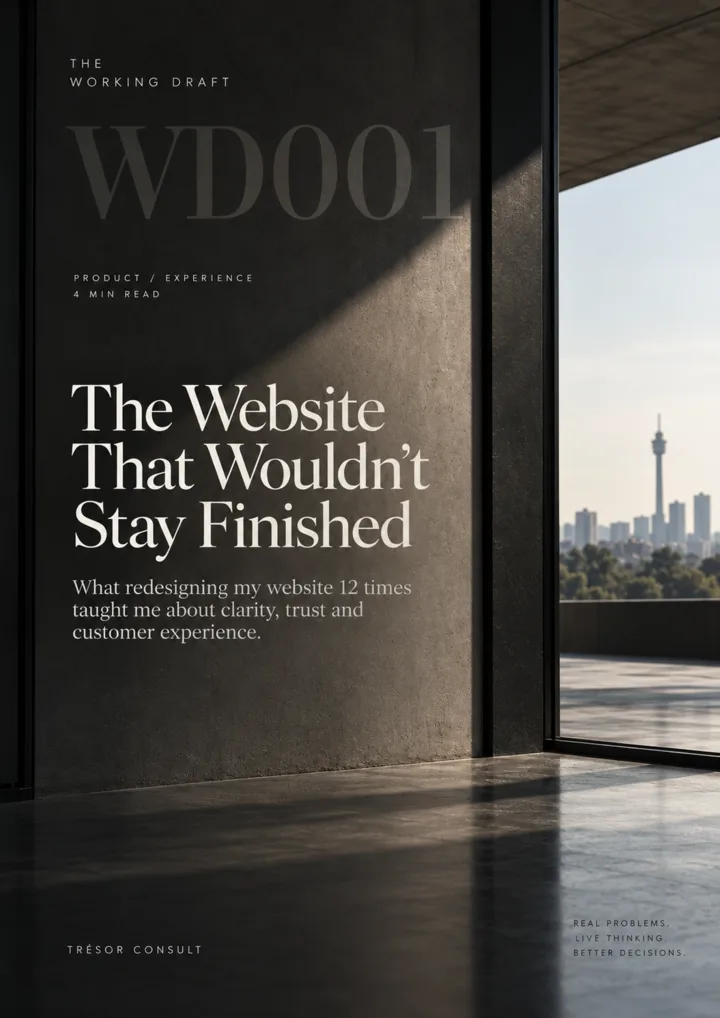
This is the first drawing set. WD001 begins with the website itself.
001 The Website That Wouldn't Stay FinishedProduct / experience / 4 min read
Working Draft 001 cover, a dark architectural interior with Johannesburg beyond the window.
WD001 / Product + experience
Current drawing

A website can become visually resolved long before the underlying idea is resolved.

We redesigned Trésor's website twelve times. The useful question was never whether version twelve looked better. It was whether the site had finally become part of the work rather than a description of it.

Drawing 01

The load-bearing idea

At different points we tried to explain the consultancy better: the methodology, the offer, why the thinking was different, why the page should feel premium. Each version could become more articulate while leaving the visitor with the same burden: what am I actually meant to do here?

That changed the design question from "How do we explain Trésor better?" to "What should happen to someone because they visited?"

A founder should be clearer before Trésor asks them for anything.

That became the load-bearing idea for this version. The founder starts with the commercial decision exactly as it exists in their head. The system makes the decision visible, places the company in context, asks only for information that changes the read, then returns what should decide it, what evidence deserves weight, what we would distrust, the smallest useful test, and what would change our mind.

Drawing 02

The website is part of the product.

We no longer think of the site as the place where Trésor describes the product. The site is the first piece of the product.

If we say we help founders make better commercial decisions, the first experience should contain some evidence of that ability. Not a claim. Not a testimonial. Not another paragraph telling you how rigorous we are. A small piece of the work.

The website therefore carries two loads at once: it has to help the founder, and it has to help us learn. If either side disappears, the structure becomes weaker.

Detail 01

Why the strange little scenes exist

Commercial uncertainty is not experienced as a spreadsheet. It is experienced as a state. Sometimes it feels like building. Sometimes it feels like noise. Sometimes it feels like sitting alone with one decision that suddenly seems to contain ten others.

The Builder, The Mess, and The Decision are not there to make the website more creative. They are there to test whether recognition can do work that another paragraph cannot.

If those scenes become more memorable than the decision itself, they have failed. If they quietly tell the founder, "you are allowed to bring it here before it is neat," they may have earned their place.

Load test 01

What this version is actually testing

A founder will trust the next step more if the first interaction creates real clarity before asking for commitment.

Underneath that are several assumptions. We believe founders will give us a real enough decision to work with. We believe the system can identify the commercial object accurately enough to ask better questions. We believe a useful first read can create more trust than a conventional explanation of the consultancy. We believe the emotional layer can create recognition without becoming decoration. We believe the right people will want to continue after receiving value, not because the page pushed them toward a call.

Those are beliefs. Not results.

Instrument 01

What we are watching

We are not particularly interested in asking whether someone likes the website. Beautiful websites are easy to like. That tells us very little.

StartCan someone understand where to begin and describe a real decision without us in the room?
ContextDo they complete the context, or does the calibration feel like work without value?
ReadDoes the first read feel specific enough to continue, and do people correct us when we compress the decision badly?
ContinuationAfter receiving value, do they ask us to keep the case for consideration?
ConversationWhen we speak afterwards, what do they say happened in their head while they used it?

Analytics can tell us where something happened. A conversation can sometimes tell us why. Neither is the truth on its own.

Falsifier 01

A useful experiment needs a way to lose.

This version should change if people consistently admire it but do not use it. If founders struggle to express their decision in the first field. If the system repeatedly identifies the wrong commercial problem. If the first read sounds intelligent but does not make the decision meaningfully sharper.

It should also change if people need a human explanation before the product becomes useful, if the emotional scenes create theatre rather than recognition, or if people request consideration because they are intrigued by the design rather than because they have a consequential decision worth working on.

Those are not edge cases we need to defend the design against. They are reasons we released it.

Boundary

What we are not allowed to conclude yet

We do not know that this is the right website. We know that it is the clearest expression so far of what we currently believe the website should do.

There is no evidence yet that the current visual system improves conversion. There is no evidence yet that the first read is useful across every founder type. There is no evidence yet that this sequence is the shortest path from messy problem to useful clarity.

What we have is something better than another opinion. We now have a version that can meet reality.

Open edge

The next draft begins when reality has had a turn.

We will look at what people actually did, where the interaction broke, where it surprised us, what founders told us, which assumptions survived, and what changed because of it.

The goal is not to prove that this version was right. The goal is to make the next version less wrong.

The drawing is now on the table.

If you used the Clarity Check, the most useful feedback is not a score. Tell us where you hesitated, what felt sharper, what felt generic, or what you expected to happen next.

Send a field note →
Thursday / The Working Draft Letter

Stay close to the work.

You are already inside the conversation. The letter is simply the quieter way to stay with it.

When there is something worth sending, we send the useful part: what we saw, what we think it means, what would change our mind, and what you can apply. No giant nurture sequence. No obligation to keep up. If a week gives us nothing useful, we would rather send nothing.

What we sawWhat we think it meansWhat would change our mindWhat you can apply

One confirmation email first. Separate from private consideration. Unsubscribe anytime.

Place the company

The same decision can be sensible at one stage and expensive nonsense at another. Three quick calibrations change the read.

Which is closest to the company right now?
What kind of company is it?
First read

What should decide this

    The thing I would distrust

    Smallest useful test

    I would change this read if

    Where this stops

    If the next useful step crosses into specialist execution, Trésor does not quietly stretch the brief. We make the boundary visible and, where it fits, can bring in a selected specialist with the relevant depth. The commercial question stays coherent; the specialist owns the specialist work.

    Private consideration

    Keep the case. Decide later.

    We are considering a limited first cohort. If this decision still fits and a suitable place becomes available, Trésor may contact you using the details you provide.

    If the reviewed version of this work proves useful, would you consider paying for the full decision work if a suitable place becomes available?
    Stored

    Your case is in the consideration pool.

    Nothing has been sold. Nothing has been accepted. If the case still fits and a suitable place becomes available, Trésor may contact you using the email you supplied.

    Trésor Partner Network

    The right problem. The right depth.

    A small network of specialists Trésor can bring into the right commercial problem when the work genuinely requires it. We match people selectively to specific problems and agree roles, economics and boundaries before anything begins.

    DepthBe unusually good at something specific enough that we know when to call you.
    EvidenceConcrete work matters more than polished positioning. The application asks for proof and real examples.
    JudgmentClient trust, boundaries, handoff quality and knowing what not to own are part of the standard.
    FitWe review the network against real client and portfolio needs rather than filling a fixed roster.
    Request partner consideration → If there is a credible fit for a specific opportunity, Trésor will contact you to discuss the problem, boundaries and commercial structure before anything begins. Applying does not create employment, exclusivity, a partnership or a commitment of work.